



…As Stakeholders Calls For Stronger Support For Investigative Reporting In A Digital World
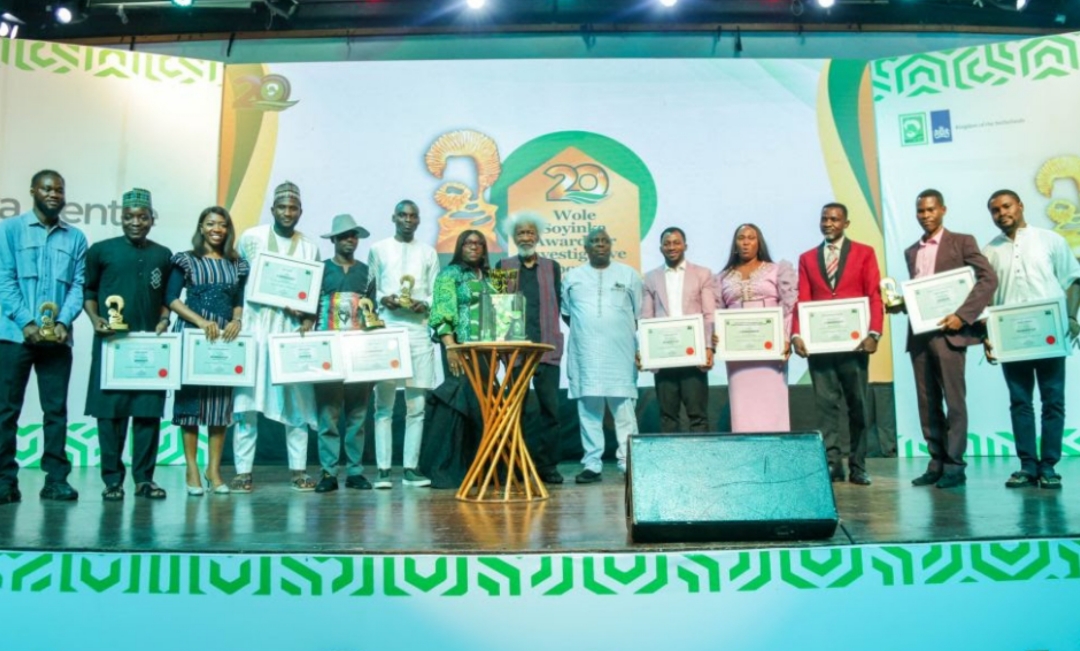
Africa’s first Nobel Laureate in Literature, Professor Wole Soyinka, graced the Wole Soyinka Centre for Investigative Journalism (WSCIJ) as they mark 20 years of fearless journalism at the 20th Wole Soyinka Award for Investigative Reporting (WSAIR) in Lagos on 9 December 2025.
This landmark celebration honoured 14 journalists for outstanding investigations and recognised the lifelong contributions of Odia Ofeimun and Justice Ayo Salami for their enduring contributions to truth, justice, and public accountability in Nigeria. Journalists, media executives, and stakeholders also turned the spotlight on the future of investigative reporting in a rapidly evolving digital age.
Speaking at the event, Professor Wole Soyinka condemned what he described as repeated “inhuman demolitions” that continue to leave citizens homeless, urging Nigeria to break the cycle of dehumanisation. The Nobel Laureate cautioned that the unchecked abuse of social media could threaten global stability, emphasising the media’s critical role in combating misinformation.
Recounting the Centre’s origin, Dapo Olorunyomi, founder, WSCIJ, highlighted its birth out of Nigeria’s struggle to deepen democracy after decades of military rule, corruption, and human rights abuses. He described journalism as a contributing force in ending military dictatorship and sustaining the fight against corruption. “Democracy will be practically impossible if we do not have good journalism, and good journalism can only be meaningful if it serves the public good,” Olorunyomi also warned that artificial intelligence, harsh economic conditions, ethical challenges, and repressive laws now pose new threats to the profession.
Michel Deelen, Consul-General of the Kingdom of the Netherlands in Lagos, in his opening remarks, challenged journalists to adapt to the changing media consumption habits of young people while maintaining the highest standards of investigative reporting. He stressed that journalism is even more critical in an era of fake news and digital manipulation, adding that the work of the WSCIJ has become more important as disinformation grows more sophisticated. Deelen noted that this shared commitment to transparency and accountability is why the Dutch Embassy has continued to partner with the Centre over the years.
Representing the Lagos State Governor, Babajide Sanwo-Olu, Gbenga Omotosho, Commissioner for Information, Lagos State, warned that core reporting is fast declining as commentary increasingly overtakes journalism in Nigeria. He praised the WSCIJ for sustaining rigorous reporting over the past 20 years, describing the milestone as a testament to resilience, courage, professionalism and loyalty to the values of investigative journalism.
Theophilus Adedokun won the Online Category with his story ‘Dangote, in Quest for Cheap Energy, pumps poison into Benue Rivers,’ in National Record. Kunle Adebajo came in as runner-up in the category for his story ‘The Internet Fundraising Marathons Behind IPOB’s Armed Struggle in Nigeria,’ in HumAngle Media, while Isa Ismaila received commendation for his report “Lost Homes, No Aid”, in HumAngle Media.
The Television category was won by Muslim Yusuf for his story ‘Inside Abuja’s Drug Problem’, aired on Trust TV. There was no runner-up or commended entry in this category. The Radio category had no winner.
In the print category, Afeez Hanafi emerged as the winner with his story ‘Journalist secures two jobs with Oluwole certificates,’ published in Daily Trust. Kingsley Jeremiah came runner-up in the category for his story “Empty plates, bleak future: How malnutrition is devastating Northern Nigeria,’ published in The Guardian, while Ann Godwin, Tina Todo, Julius Osahon, and Monday Osayande were commended for their joint story “South South: An Oil-Rich with Dunghills of Abandoned Projects.”

Elliot Ovadje clinched the winning prize and the commendation for the Photo Category, with his stories, ‘Beneath the Black Gold: Oil-rich Niger Delta’s Paradox of Plenty and Pain’, and ‘Rivers community falls into ruin as oil spill destroys livelihoods’, respectively published in The Punch. Ugonma Ogbu-Matthia emerged runner-up for her photo, ‘Left Behind- Free Education Pushes Nomadic Children in Nigeria’s Capital to Learn Beneath Trees, Under the Rain’, published in African Angle.
In the Editorial Cartoon category, Victor Asowata won with Gross Dereliction, published in The Will newspaper, while his second entry, The Medical Tourist, emerged as runner-up. Chukwuemeka Emenike’s Glitches Syndrome, published in New Telegraph, received a commendation. Winners received an award plaque, a certificate, a cash gift, and an international trip. Runner-ups got a certificate of commendation and a cash gift. Finalists whose works were commended got a certificate of commendation and a cash gift.
In her speech titled ‘Architects of accountability: A Verdict on the future of truth’, Professor Abigail Ogwezzy-Ndisika, chair, 2025 Awards Judges’ Board, disclosed that the board received a total of 180 entries of which 129 were valid. The entries include, 64 online, 32 print, 11 television, eight radio, eight photo, and six editorial cartoons and were assessed on courage, depth, accuracy, impact and public interest. She raised concern over the growing challenges in radio reporting despite its wide reach, and urged journalists to embrace truth, resilience, deeper research and precision in addressing Nigeria’s social and environmental challenges.
WSCIJ presented the Lifetime Award for Journalistic Excellence to Odia Ofeimun, acclaimed writer, poet and political scientist for his outstanding contributions to Nigerian journalism, literature, and public discourse. The Human Rights Defender Award was conferred on Justice Ayo Salami for his steadfast commitment to justice, integrity, and protection of human rights.
Over 20 years, WSCIJ has supported more than 10,000 journalists, strengthened over 180 media organisations, and driven stories that exposed corruption, challenged impunity, and deepened public trust in journalism. Since the first WSAIR in October 2005, the award has produced 144 finalists, 71 Soyinka Laureates, 13 investigative journalists of the year, and 33 honorary award recipients.
Reflecting on the future of investigative journalism, Motunrayo Alaka, Executive Director/CEO, WSCIJ, reaffirmed three priorities: local, digital, and collaborative. She emphasised that journalism must be rooted in communities, embrace technology, and pursue collective efforts, noting that no organisation can tackle systemic issues alone. “The future of investigative journalism depends on collective effort; no organisation can do it in isolation,” she added.
Closing the event, Laura Ede, Associate Director, Programmes, thanked Professor Wole Soyinka, Dapo Olorunyomi, partners, funders, board members, finalists, laureates, judges, and staff for their unwavering support over the past two decades. “Two decades in, and the engine is still running because of people like you,” she said, urging everyone to stay inspired and continue championing the truth.
This year, the award presentation and anniversary ceremony, moderated by Nifemi Oguntoye, broadcast journalist at TVC Communications, and Ini John-Mekwa, Deputy Editor & Head of Business Desk at Channels Television, concluded the two-day Amplify In-depth Media (AIM) Conference themed “WSCIJ@20: Investigative Reporting and the Future of Truth.” The ceremony also featured a dynamic performance by the Karkarky Dance Group and uplifting music from the Sholah Band.
Looking ahead, WSCIJ will inaugurate a new set of board members, bringing fresh energy, expertise, and commitment to the Centre’s mission of defending investigative journalism. As it celebrates two decades of courageous reporting, WSCIJ reaffirms its role in supporting journalists, advancing truth, and upholding accountability in Nigeria’s media landscape.