



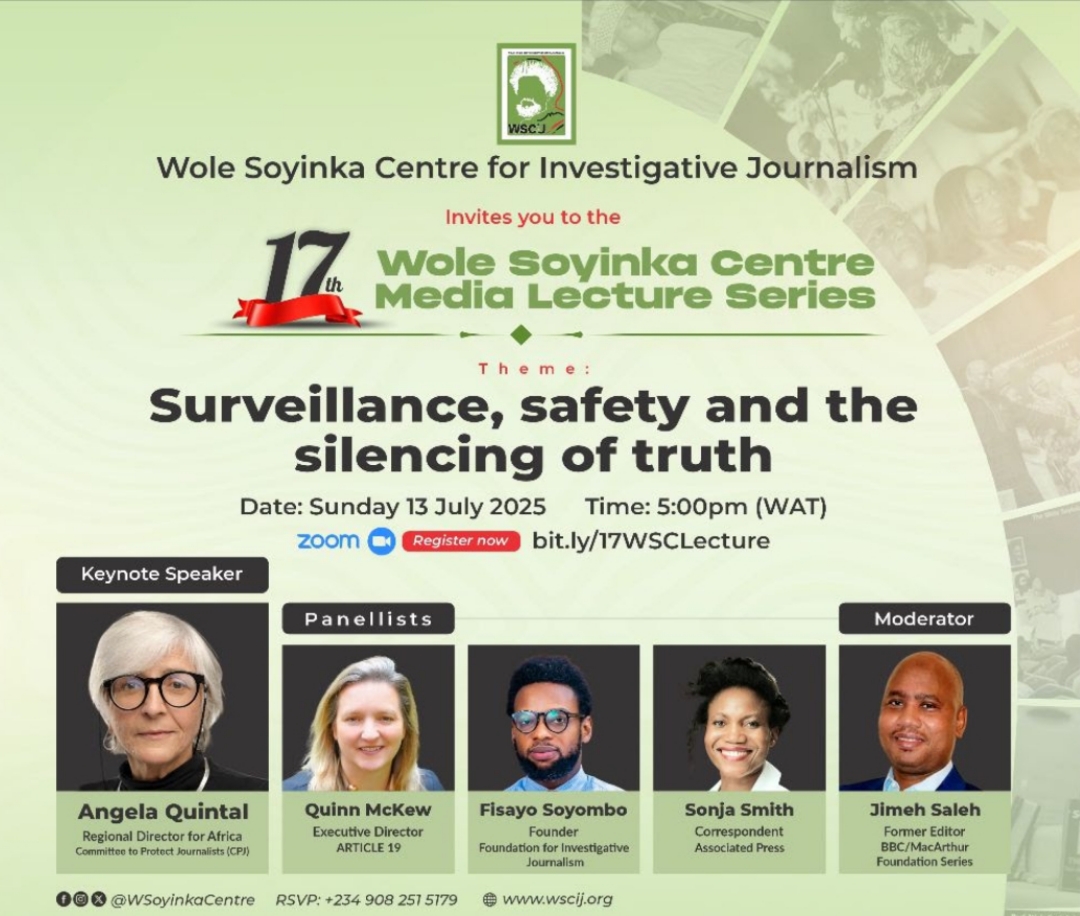
Speakers at the 17th Wole Soyinka Centre Media Lecture, which was held virtually on 13 July 2025, have called for urgent action to protect journalists in Africa from escalating surveillance and digital threats. They also called for the enactment of clear privacy protections by governments, the development of technology that safeguards rather than endangers press freedom and greater public awareness of the consequences of silencing the media.
According to the speakers, journalists must not be left to face these sophisticated threats alone, as each attack on press freedom represents a broader assault on democracy itself. The lecture, held in the continued tradition of celebrating the birthday of Nobel Laureate and grand patron of the Wole Soyinka Centre for Investigative Journalism (WSCIJ), Professor Wole Soyinka, who turned 91 this year, was themed: “Surveillance, safety and the silencing of truth.”
The event featured Angela Quintal, Regional Director for Africa at the Committee to Protect Journalists (CPJ), as keynote speaker alongside panellists Quinn McKew, Executive Director of ARTICLE 19; Fisayo Soyombo, Founder and Editor-in-Chief of the Foundation for Investigative Journalism (FIJ); and Sonja Smith, Associated Press correspondent. The session was moderated by Jimeh Saleh, former Editor, British Broadcasting Corporation (BBC)/MacArthur Foundation Partnership Series.
Opening the conversation, Founder and Chief Executive Officer of the Centre for Journalism Innovation and Development (CJID) and WSCIJ’s founder, Dapo Olorunyomi, described surveillance as a widespread and institutionalised threat that now extends beyond espionage, posing serious risks to journalists’ safety and undermining democratic freedoms. Olorunyomi acknowledged that the digital age has revolutionised journalism, offering tools to tell stories with unprecedented reach. However, he warned that it has also created a darker terrain where the interests of governments, corporations and surveillance industries intersect.
Quintal, in her keynote address, highlighted the hidden and often silent war being waged against journalists through spyware, metadata harvesting and transnational monitoring. She stated that surveillance has become a tool to instil fear and suppress dissent.
She explained that the intrusion into journalists’ private communication undermines their ability to protect sources, conduct investigations and hold the powerful accountable. Drawing from her experiences, including detention in Tanzania and cases in countries such as Nigeria, South Africa, Togo and Botswana, Quintal emphasised the issue’s breadth and severity. Quintal, therefore, called for comprehensive legal reforms, improved digital safety mechanisms and recognition across the continent that privacy is essential to journalism.
On his part, Soyombo reflected on how persistent harassment and surveillance are discouraging young people from joining the profession. He shared a student journalist’s message expressing growing disillusionment with journalism because of increasing attacks on practitioners. Soyombo criticised the Nigerian government’s prioritisation of surveillance, arguing that its heavy investment in monitoring tools reflects a greater interest in tracking critics than in ensuring public safety.
Soyombo explained that this issue is not limited to journalists, as he argued that the public must see attacks on the media as attacks on their own rights. He called for stronger resistance to digital repression, better institutional protections for journalists and increased awareness of the broader implications of surveillance.

Lending her voice to the conversation, McKew linked the spread of surveillance with broader efforts by authoritarian regimes to control narratives and suppress public criticism. She explained that governments are increasingly using national security laws, cybercrime legislation, and smart city technologies to monitor citizens and journalists. McKew warned that these developments are part of a growing global information warfare strategy, where control over digital and physical spaces is central to maintaining power.
She pointed to the combination of state surveillance, legal suppression and corporate data collection as a dangerous mix that compromises press freedom. McKew advocated for a global prohibition on the use and export of spyware, stronger data protection laws and reforms to close loopholes that allow governments easy access to sensitive data.
Namibian investigative journalist Smith addressed the challenges journalists face in Southern Africa, particularly women. She described how surveillance is often personal and gendered, with threats of sexual violence, smear campaigns and emotional pressure used to silence women journalists. Smith shared experiences from Namibia, including mandatory SIM card registration, which raised concerns about state monitoring.
She called for stronger protection mechanisms for journalists outside major cities and institutional media houses. She also urged donors and platforms to acknowledge the disproportionate risks women and journalists face in remote areas.
In her closing remarks, Motunrayo Alaka, WSCIJ’s Executive Director/CEO, highlighted the need to treat surveillance and the suppression of dissent as a broader societal threat. She noted that over the past four years, WSCIJ has convened multiple forums focused on civic space, press freedom and journalist safety in response to what she described as a “sophisticated and intentional” attack on truth and accountability.
Alaka highlighted the growing atmosphere of fear that surveillance creates within civic space, where individuals increasingly question their safety before speaking out. According to her, this climate makes public education around rights and media literacy more important than ever.
Alaka also urged media owners and newsroom leaders to take greater responsibility for protecting journalists and defending the civic space. She stated that editors and publishers must become more active and visible in safeguarding press freedom.
The WSCIJ also used the occasion to highlight its support services for journalists to mitigate the threat. They include mental health and psychosocial support for journalists and research efforts to track, analyse, and engage stakeholders concerning the threats against Nigeria’s civic space.
The well attended lecture was held online for the fourth time since its inception. Previous lecture editions have explored several public interest issues, including electoral reform, media challenges, local governance, national security, the Freedom of Information Act (FOIA), corruption, oil revenue, tax regime, basic education, electricity, conflicts and peace-building.
The lecture has contributed immensely to policy shifts in Nigeria, most recently being the tax reform bill signed into law in June 2025. The 8th Wole Soyinka Centre Media Lecture held in 2016 discussed and recommended an “inclusive, simplified and automated tax regime” in Nigeria.
The 17th Wole Soyinka Centre Media Lecture is available on WSCIJ’s YouTube channel for public viewing.